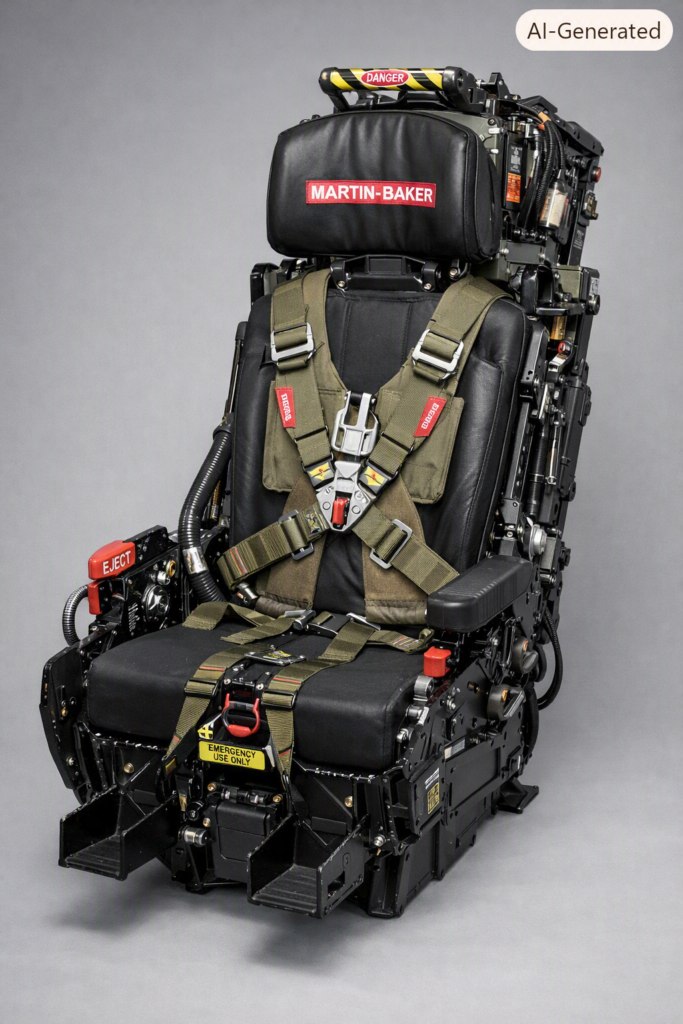
On the 21st July the Stem group had a talk by one of our members on the Martin-Baker Ejector Seat. Phil Johnson is an ex-RAF armourer. He initially gave a brief history of the company, which can be viewed at Our History – Martin-Baker.
The requirement for ejection arose as aircraft speeds increased with the introduction of the jet engine. Design requirements were laid down in the 1940s and are still valid today:
- Initiate the ejection
- Clear a path
- Restrain & remove the occupant quickly & safely
- Maintain life support – Emergency Oxygen
- Take the occupant a safe distance away
- Release the occupant from the seat & deploy a parachute – Automatically or Manually
- Provide them with survival equipment – Water/Food/Dinghy/Tools/Money etc.
The time for ejection takes around 0.2 of a second. During that time the seat with pilot is accelerated at a rate between 12g – 20g meaning a 100kg occupant weighs between 1200-200kg for a short time and gains altitude of 150 to 200 feet during the ascent. It was determined during the early development that explosive charges were the best means of providing the propulsion required. A safe level for the stresses on the body also had to be determined using a human test pilot. In 1946 Bernard Lynch carried out the first test ejection from a modified Meteor aircraft. He continued to act as the human guinea pig in the ensuing development. Two Meteors continue to be test beds to this day.
The main parts of the design are:
- telescopic ejection gun
- main beam structure
- seat pan
- parachute and survival pack
The sequence of events are:
- primary cartridge in the ejection gun jettisons the canopy and starts to raise the seat and occupant
- successive charges give a controlled acceleration
- Drogue released and stabilises the seat, and opens full parachute
- Occupant released from seat
To date over 7000 pilots have been saved by ejecting from a stricken aircraft. Clearly a life-saver!